Chelsea Plating Company
  • Home
  • About
  • Restoration Services
    • Silver Restoration and Repair >
      • Silver Repair Services
      • Silver Plating and Replating
      • Sterling Silver Polishing and Cleaning
    • Brass, Copper and Bronze Restoration and Repair >
      • Brass Restoration and Repair
      • Brass Polishing and Cleaning
      • Brass, Copper and Bronze Refinishing and Lacquer Removal
      • Antique Brass Hardware Restoration and Refinishing
      • Brass Bed Restoration and Polishing
    • Gold, Gilding and Plated Surface Restoration >
      • Gilded and Gold-Plated Decorative Object Restoration
      • Gilded Frame and Mirror Restoration and Repair
      • Gold Plating and Replating
    • Ceramic and Porcelain Restoration and Repair >
      • Ceramic Restoration and Pottery Repair
      • Porcelain Repair and Fine China Restoration
      • Fine China and Dinnerware Repair
      • Pottery and Studio Ceramics Repair
      • Ceramic Vase and Decorative Object Repair
      • Ceramic Lamp and Lighting Base Restoration
      • Porcelain and Ceramic Figurine Restoration
    • Antique Lamp and Light Fixture Restoration >
      • Lamp and Chandelier Rewiring and Restoration
    • Heirloom, Decorative Art and Religious Object Restoration and Repair >
      • Trophy Repair and Presentation Piece Restoration
      • Religious and Ecclesiastical Metal Object Restoration
      • Samovar Restoration and Repair
      • Judaica Restoration and Repair
  • Contact
  • Frequently Asked Questions
Brown transferware earthenware bowl reassembled from multiple breaks; losses filled and pattern matched for continuous rim and interior.
Transfer-printed earthenware bowl, 19th-century English—impact break reassembled; losses compensated and toning balanced to preserve pattern continuity and period surface.

Ceramic Restoration

Conservation-grade restoration for non-porcelain ceramics, pottery, vessels, tiles, and sculpture.
Chelsea Plating Company restores ceramic objects for clients in Philadelphia and throughout the United States. Ceramic restoration includes earthenware, stoneware, terracotta, Majolica, creamware, ironstone, faience, Talavera-style pieces, studio pottery, and other non-porcelain ceramics. Typical projects range from mixing bowls, serving dishes, and pitchers to art pottery, lamps, and sculptural work. Breaks are reassembled, losses rebuilt, and surfaces clarified so the form reads as a whole while the original material remains legible. Many clients find us while searching for ceramic repair near them and choose to ship their pieces to our Philadelphia workshop; we provide packing guidance in advance and arrange return shipping when treatment is complete.
REQUEST AN ESTIMATE
Send clear photos and dimensions to begin.

AT A GLANCE — CERAMIC RESTORATION

  • Restoration for earthenware, stoneware, terracotta, Majolica, creamware, ironstone, faience, and art pottery
  • Tableware and serving pieces: bowls, plates, platters, pitchers, tureens, ladles, and specialty forms
  • Decorative vessels and jars, including lidded boxes, flower pots, Talavera-style planters, and advertising jars
  • Figurines and sculptural work: animals, religious figures, mid-century art pottery, and contemporary pieces
  • Lamps and lamp bases where the ceramic body is damaged and can be safely detached for treatment
  • Structural reassembly of simple and complex breaks, including multi-piece and multi-panel losses
  • Chip, rim, and handle rebuilds to restore profile and support stable decorative display
  • Compensation of losses with color-matched fills and inpainting to integrate decoration
  • Treatment limited to pieces that can be safely shipped or hand-delivered to the workshop; no on-site work
  • Decorative use emphasized after treatment; adhesives and fills are not food- or heat-safe
Large ceramic water carrier statue before and after restoration, shattered sections reassembled and surface retouched.
Water carrier figure — major breakage reassembled, arm, head, and vessel structurally restored.

CERAMIC TABLEWARE AND SERVING PIECE RESTORATION

Much of the ceramic restoration work at Chelsea Plating Company involves tableware and serving pieces that have been in regular use for years. Mixing bowls, serving bowls, deviled egg plates, platters, pitchers, tureens, covered dishes, and hobby ceramics often arrive in multiple fragments. These objects may be mid-century or later, but they are treated with the same care as earlier wares because of their role in family histories.

Breaks are dry-fitted and aligned before any adhesive is introduced. Once joins are confirmed, conservation-grade adhesives are used to reassemble the body. Chips and losses at rims, feet, handles, and pouring lips are rebuilt with shaped fills that restore the original outline. For patterned pieces—chintz florals, transfer prints, Majolica relief decoration, ironstone borders, and printed advertising designs—the decoration is carried across the new fills so the pattern reads continuously at normal viewing distance while still allowing the original ceramic body to remain legible on close inspection.

Ceramic restoration and pottery repair for these objects is planned to stabilize structure and clarify surface without overstatement. The result is a coherent presentation that respects both the original making and the piece’s history of use, now intended for decorative display.
Turkish Iznik-style covered bowl before and after restoration, broken lid fragments reassembled and retouched.
Iznik-style covered bowl — shattered lid reconstructed, floral pattern carefully rejoined.

CERAMIC FIGURINES, LAMPS, AND ART POTTERY

Many ceramic restoration projects involve figurines, sculptural objects, lamps, and art pottery. Animal groups, angels, religious figures, mid-century decorative pieces, studio sculpture, and hand-thrown vessels may present with broken bases, detached limbs, complex fractures through the body, or losses at small modeled details. Ceramic figurine repair focuses first on structure: fractures are reassembled in stages so that weight-bearing joins are secure and the posture of the piece is recovered.

Once the form is stable, losses at paws, tails, limbs, edges, and small sculptural details are rebuilt to echo the original modeling. Fills are then refined and toned so transitions sit quietly within the surrounding glaze or painted surface. Art pottery restoration follows the same approach, whether the piece is a signed studio vase, a mid-century lamp base, or a one-of-a-kind sculptural form. For ceramic lamp bases, work is limited to bodies that can be safely detached and shipped; electrical components remain with the client’s chosen lamp specialist.
​

Throughout figurine and art pottery restoration, the priority is a calm, unified read at normal viewing distance rather than the complete erasure of every trace of damage. The aim is to return the piece to confident display while preserving its character and history.
Before-and-after detail of a blue and white ceramic table lamp: in the first view the socket area is broken away with a jagged hole in the top of the animal-shaped base, and in the second view the ceramic around the metal socket has been fully rebuilt and repainted so the bird and foliage pattern looks continuous.
Blue-and-white Chinoiserie ceramic lamp — shattered socket opening rebuilt, losses filled, and painted to match the original bird-and-foliage design.

PROCESS, SHIPPING, AND PROJECT SCOPE

Most ceramic restoration and pottery repair projects begin with clear photos and basic dimensions. From these, an initial treatment range can often be provided, along with notes on previous repairs, missing fragments, or fragile areas. Once the piece arrives at the Philadelphia workshop, it is reviewed at the bench and a written estimate is confirmed before work proceeds. Only objects that can be safely packed, shipped, or hand-delivered are accepted; permanently installed or oversized pieces that cannot travel to the workshop are generally out of scope.

Old tape, glue, staples, or discolored overpaint are reduced or removed when it is safe for the ceramic body and surface. Joins are tested dry until alignment is correct, then bonded with conservation-grade adhesives. Fills are built in stages to reduce stress on the original material, then shaped and refined to match adjoining profiles. Final toning and glazing are carried out under controlled light so restored sections sit quietly in normal room conditions.
​

Adhesives and fills used in ceramic restoration are not food-safe or heat-safe. Restored ceramics are recommended for decorative display only and should not be used with food, dishwashers, microwaves, or ovens. For objects that were once functional, treatment focuses on safe and stable display while acknowledging their history of use.
Perforated blue studio pottery plate before and after restoration, broken segments rejoined and pattern aligned.
Perforated studio plate — multi-piece break reassembled, spiral center and cutouts aligned.
REQUEST AN ESTIMATE
​Send clear photos and dimensions to begin.

BEFORE AND AFTER GALLERY

The ceramic restoration gallery shows typical outcomes rather than a fixed standard. Some pieces are fully integrated visually so that decoration and form read as continuous at normal viewing distance. Others retain discreet evidence of age and repair by client request. Together, the examples illustrate how structural stability, profile reconstruction, and measured surface integration can return damaged ceramics to cohesive display.
Antique angel wall plaque before and after restoration, broken fragments reassembled and toned.
Angel wall plaque — shattered fragments reassembled, losses filled, surface tone unified.
Wedgwood Philadelphia bowl before and after restoration, shattered creamware fragments rejoined with design matched.
Wedgwood Philadelphia bowl — sixteen fragments reassembled, transfer print and motto aligned.
Hand-painted Talavera-style flower pot before and after restoration, split body rejoined and decoration matched.
Talavera-style flower pot — vertical break reassembled, hand-painted floral panel aligned.
Ceramic soup ladle before and after restoration, broken handle sections reattached and reinforced.
Ceramic soup ladle — broken handle pinned, join strengthened, floral bowl stabilized.
Mid-century ceramic ram figurine before and after restoration, damaged muzzle and leg rebuilt and glaze matched.
Royal Haeger ram — broken muzzle and leg rebuilt, layered glaze matched.
Ceramic deviled egg plate before and after restoration, missing rim section rebuilt and painted.
Deviled egg plate — rim loss rebuilt, scattered floral decoration reintegrated.
Cobalt blue ceramic camel figurine before and after restoration, detached head reattached and blended.
Cobalt blue camel — broken head reattached, glossy glaze and profile restored.
Royal Winton Hazel chintz serving tray before and after restoration, broken fragments reassembled and pattern matched.
Royal Winton chintz tray — shattered sections rejoined, dense floral pattern continued.
Vintage Grey Poupon Dijon mustard jar with heavy rim loss before restoration and the rim rebuilt and profile corrected after restoration.
French Grey Poupon mustard jar — chipped rim rebuilt and profile corrected.
Ceramic bunny-on-egg trinket box before and after restoration, broken lid reassembled and retouched.
Bunny egg trinket box — shattered lid rebuilt, decoration matched for display.
Antique ironstone pitcher before and after restoration, shattered body reassembled and painted iris motif rejoined.
Ironstone Red Iris pitcher — body rebuilt from shards, floral panel reintegrated.
Black and white striped ceramic teapot before and after reassembly, inspired by Peter Shire’s Memphis Design aesthetic.
Peter Shire–style ceramic teapot — striped postmodern form reassembled.
French blue and white faience plate before and after restoration, broken rim sections reassembled and decoration matched.
French faience plate — large rim break rejoined, blue bird and florals aligned.
Vintage Sadler Mallard train teapot before and after restoration, missing spout section rebuilt and painted.
Sadler Mallard train teapot — front spout section rebuilt and streamlined body rejoined.
Monumental Liverpool creamware jug shown before and after surface cleaning and conservation work.
Monumental Liverpool creamware jug — surface cleaned, losses filled, transfers stabilized.
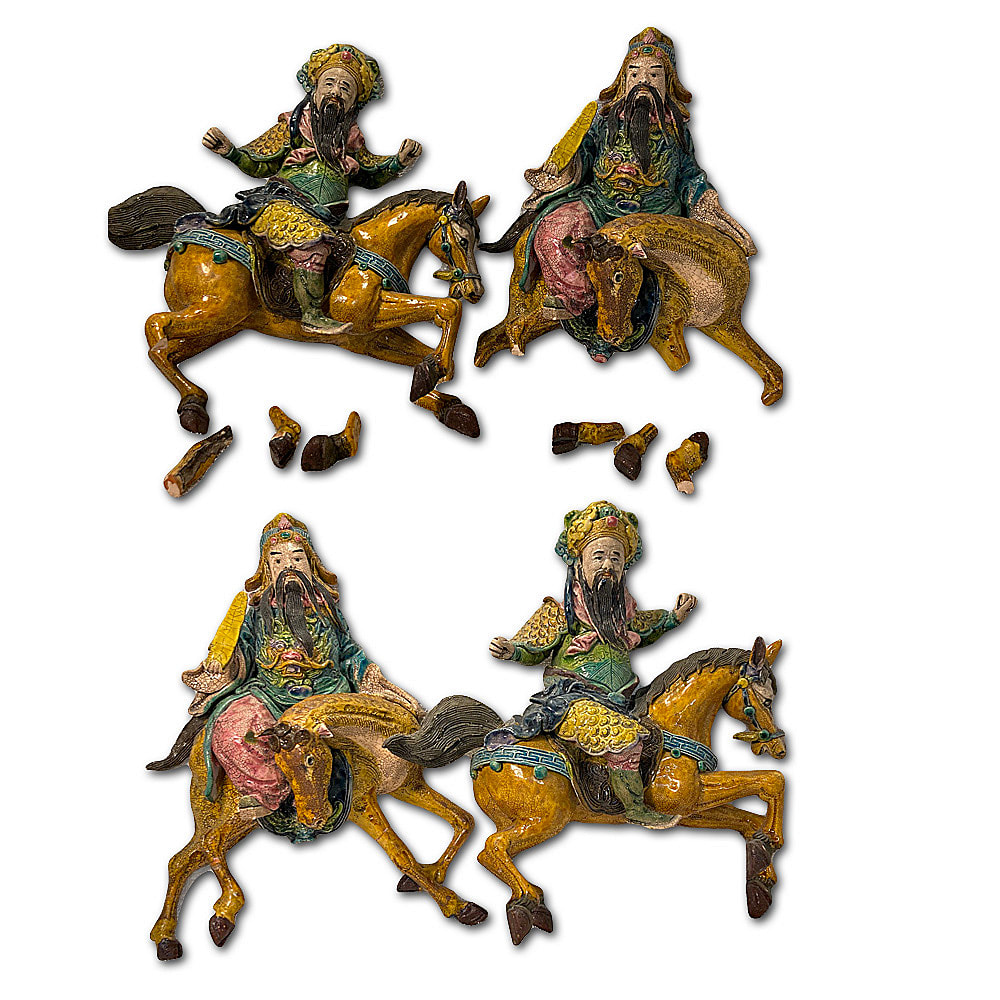
Two colorful Chinese ceramic horse-and-rider figures shown first with detached legs and fragments, then fully reassembled after restoration.
Pair of Chinese sancai-glazed horse-and-rider figures — broken legs and losses reconstructed and glaze tone blended.
Antique Staffordshire transferware bowl before and after conservation, showing close-ups of a large rim chip and stained crack at the top and the fully restored bowl below with the yellow rim, scalloped edge, and black scenic landscape returned to an even, stable finish.
Staffordshire transferware bowl with a chipped yellow rim and long body crack; loss rebuilt, crack stabilized, and the scenic “American view” interior preserved for display.
Vintage ceramic Dutch girl salt shaker shown before and after restoration: at the top, the small figure’s body is missing its head and one arm, which lie nearby as separate shards; at the bottom, the same figurine appears fully restored, with the head and arm reattached and the glossy red, blue, and white glaze blended to hide the previous damage.
Vintage Dutch-girl ceramic shaker with detached head and arm reassembled and in-painted so the bright red, blue, and white glaze reads as one continuous figure again.
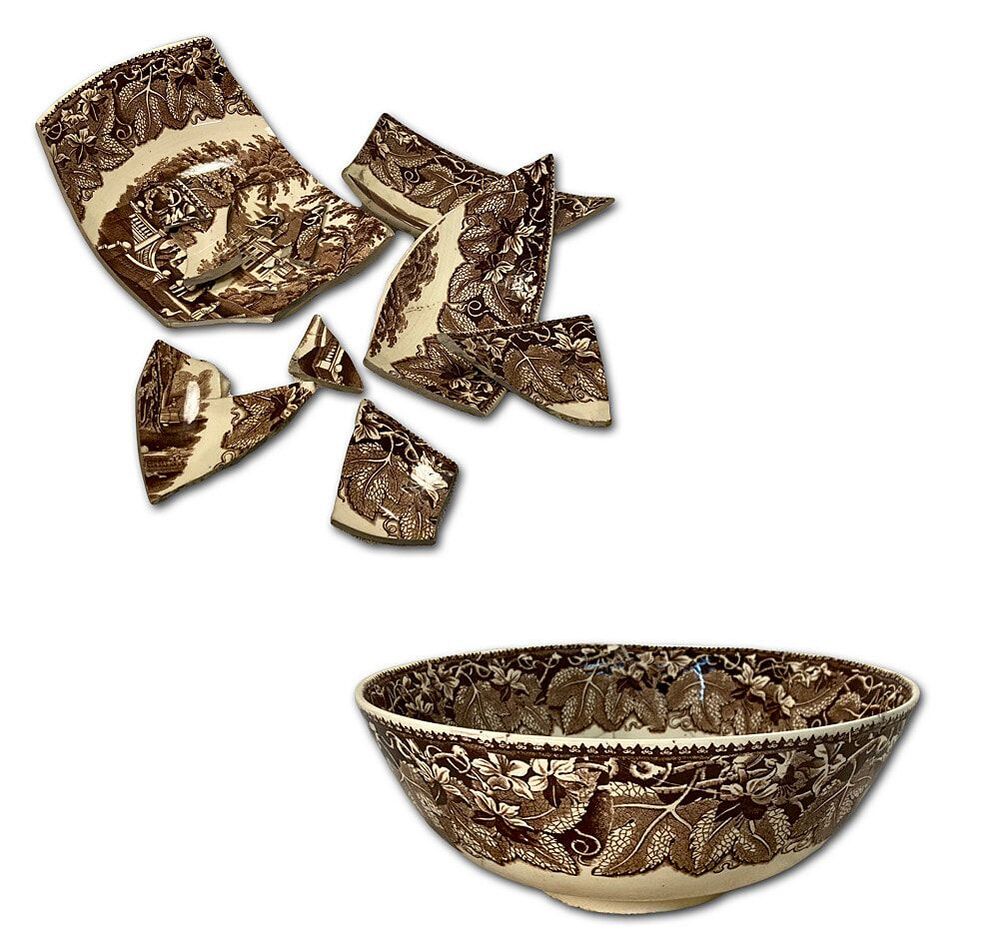
Brown and white transferware serving bowl before and after restoration, broken shards rejoined and decoration aligned.
Brown transferware bowl — multiple body fragments reassembled, scenic border pattern restored.
Yellow ceramic serving bowl with blue rim and handles, rim section broken and then fully restored.
Earthenware serving bowl with twin handles — chipped rim rebuilt, losses filled, decoration retouched.
Tall cylindrical Toshiko Takaezu–style “tree form” ceramic sculpture shown before and after restoration: on the left, the vessel stands in two large broken sections with several loose shards at the base, exposing the rough yellow clay interior; on the right, the same piece appears fully rejoined and upright, with its vertical brown, blue, and rust glazes reading as an unbroken, sculptural column.
Tall Toshiko Takaezu tree-form sculpture reassembled from multiple breaks and restored so the streaked earth-tone glazes flow seamlessly again.
Before-and-after of a ceramic pineapple table lamp showing the base in many broken shards on the left and fully reassembled with its brass hardware on the right.
Vintage ceramic pineapple table lamp — shattered base reassembled, losses filled, and surface retouched for a seamless repair.
Antique occupational barber shaving mug before and after restoration, showing an early mug with a chipped handle, worn rim, and faded scissors-and-razor design above, and the same mug below with the handle rebuilt, rim damage filled, and decoration and gold trim carefully in-painted for a unified finish.
Antique barber’s shaving mug with losses to the handle and rim; chips rebuilt, glaze and gilt retouched, and the barber’s tools motif brought back into clear focus.
Antique French blue and white transferware plate shown before and after restoration, with the upper image displaying the dish split into two large curved fragments and the lower image showing the fully reassembled plate, its scalloped rim, patterned border, and central scene of figures gathered on a quay restored to a single, stable piece.
Antique blue-and-white French transferware “talking plate” in two large broken sections, carefully rejoined so the ornate border and harbor scene read as a continuous design once again.
Trompe-l’œil ceramic sculpture by Victor Spinski shown before and after restoration: at the top, the work lies in pieces with broken ceramic bottles and faux wooden planks scattered apart; at the bottom, the same elements have been expertly rejoined into an intact crate heaped with realistically modeled “trash,” documenting a successful Chelsea Plating Company repair.
Trompe-l’œil ceramic crate by Victor Spinski, its shattered “bottles” and boards carefully reassembled and conserved in the Chelsea Plating Company studio.

FAQ

WHAT TYPES OF CERAMICS DO YOU RESTORE?
Non-porcelain ceramics including earthenware, stoneware, terracotta, Majolica, creamware, ironstone, faience, Talavera-style pieces, art pottery, studio ceramics, lamps, and ceramic sculpture. Photos and any maker’s marks are helpful if you are unsure how your piece is classified.


CAN YOU FIX COMPLEX BREAKS OR MISSING PIECES?
Yes. Multi-fragment breaks are reassembled in stages, and missing areas such as rims, handles, feet, and small modeled details can often be rebuilt. The scope of reconstruction depends on how much original material remains and the structural demands of the piece.


WILL THE REPAIR BE VISIBLE?
The aim is a calm, unified read at normal viewing distance. Joins are aligned and refined; fills are color-matched and toned to the surrounding surface. Under strong raking light or very close inspection, some evidence of restoration may still be visible, which is appropriate for conservation work.


CAN RESTORED CERAMICS STILL BE USED FOR FOOD OR HOT LIQUIDS?
No. Modern conservation adhesives and fills are not rated as food- or heat-safe. Restored ceramics should be used for display only and kept away from dishwashers, microwaves, and ovens.
​

HOW DO I START A CERAMIC RESTORATION PROJECT?
Email clear photos—overall views and close-ups of the damage—along with measurements and any background information. The images will be reviewed, a likely treatment approach outlined, and an estimate and timeline provided. Packing guidance is offered before you ship, and return shipping from the workshop is arranged once the work is complete.
REQUEST AN ESTIMATE
Send clear photos and dimensions to begin.

RELATED

  • Ceramic & Porcelain Restoration — full overview of ceramic and porcelain conservation
  • Porcelain Repair — fine china and decorative porcelain work
  • Request an Estimate — begin with photos and measurements

Location

​​Chelsea Plating Company
920 Pine Street
Philadelphia, PA 19107

Monday-Friday   8-4

215.925.1132

[email protected]

site navigation
​

  • Ceramic and Porcelain Restoration
  • ​Silver Restoration
  • Brass Restoration
  • Gold Plating, Gold Leafing, and Gilding
  • Lamp and Light Fixture Restoration
  • Heirlooms, Fine Art, and Religious Items
  • FAQ
  • Contact Us
  • Home
  • About
  • Restoration Services
    • Silver Restoration and Repair >
      • Silver Repair Services
      • Silver Plating and Replating
      • Sterling Silver Polishing and Cleaning
    • Brass, Copper and Bronze Restoration and Repair >
      • Brass Restoration and Repair
      • Brass Polishing and Cleaning
      • Brass, Copper and Bronze Refinishing and Lacquer Removal
      • Antique Brass Hardware Restoration and Refinishing
      • Brass Bed Restoration and Polishing
    • Gold, Gilding and Plated Surface Restoration >
      • Gilded and Gold-Plated Decorative Object Restoration
      • Gilded Frame and Mirror Restoration and Repair
      • Gold Plating and Replating
    • Ceramic and Porcelain Restoration and Repair >
      • Ceramic Restoration and Pottery Repair
      • Porcelain Repair and Fine China Restoration
      • Fine China and Dinnerware Repair
      • Pottery and Studio Ceramics Repair
      • Ceramic Vase and Decorative Object Repair
      • Ceramic Lamp and Lighting Base Restoration
      • Porcelain and Ceramic Figurine Restoration
    • Antique Lamp and Light Fixture Restoration >
      • Lamp and Chandelier Rewiring and Restoration
    • Heirloom, Decorative Art and Religious Object Restoration and Repair >
      • Trophy Repair and Presentation Piece Restoration
      • Religious and Ecclesiastical Metal Object Restoration
      • Samovar Restoration and Repair
      • Judaica Restoration and Repair
  • Contact
  • Frequently Asked Questions