SAMOVAR RESTORATION AND POLISHINGRestoration, cleaning, and polishing of traditional Russian brass samovars and related hot water urns.
Chelsea Plating Company in Philadelphia restores traditional Russian samovars for clients in the city and across the United States. Most projects are classic brass Russian samovars with charcoal chimneys, side handles, and ornate taps, joined by a smaller number of European urns and hotel pieces. Many visitors first find the workshop while searching for Russian samovar restoration, samovar repair, or brass samovar polishing near them and choose to ship their pieces to Philadelphia. Work focuses on careful exterior cleaning, polishing, tone adjustment, and stabilization so samovars present well as decorative objects and display pieces.
Send clear photos and dimensions to begin.
|
AT A GLANCE
|
TRADITIONAL RUSSIAN BRASS SAMOVARS
|
The most common pieces in the workshop are traditional Russian brass samovars: tall urn-shaped bodies with side handles, a central chimney, and a distinctive spout assembly. Many have engraved bands, presentation inscriptions, or maker’s marks that are hard to see under layers of soot, oxidized lacquer, and tarnish. Bases and feet often show active corrosion from long storage, while taps may be stiff, stained, or misaligned.
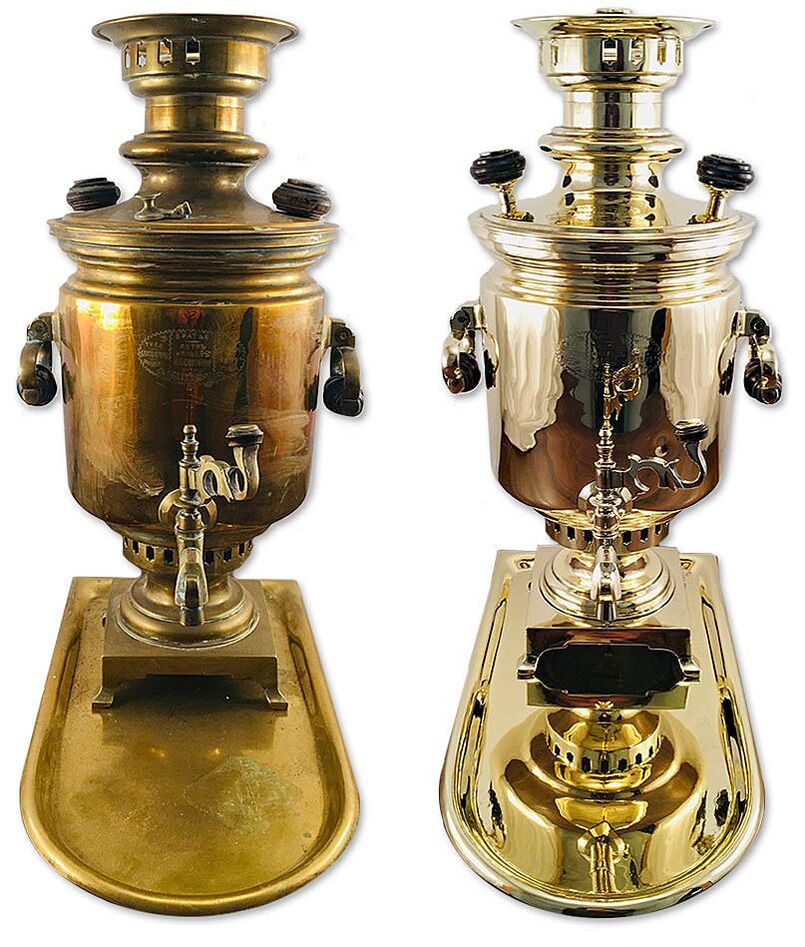
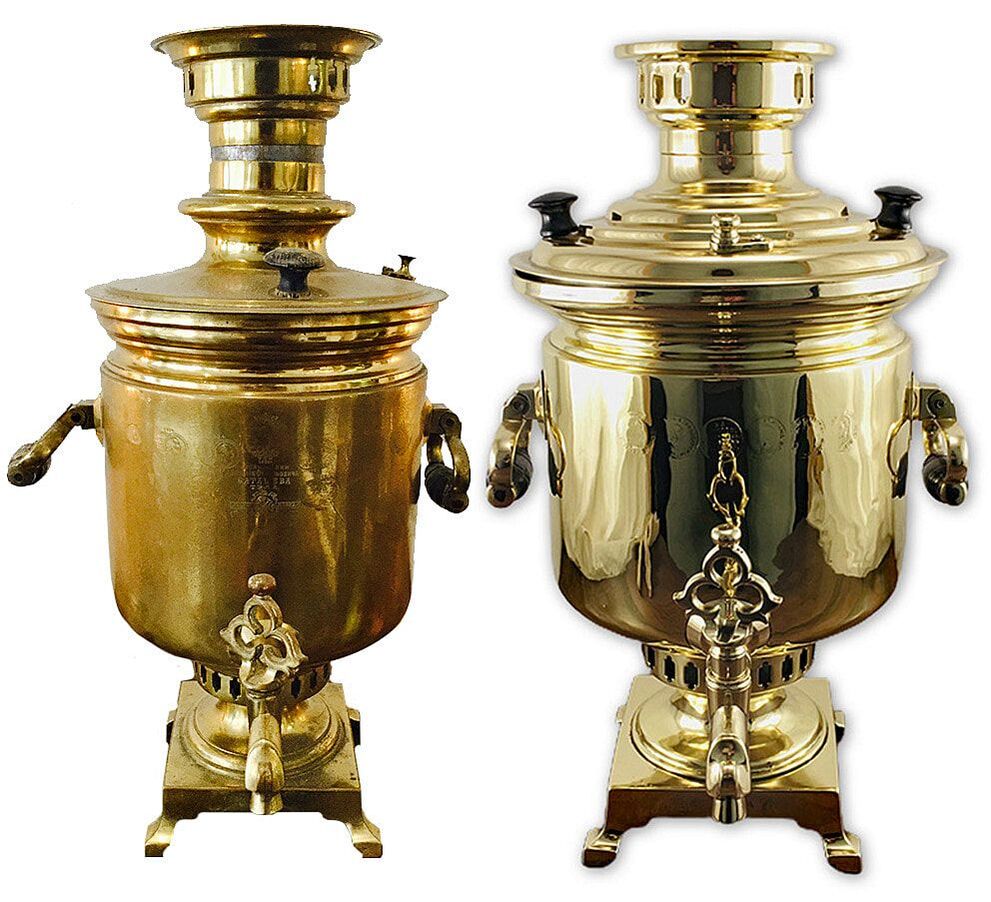
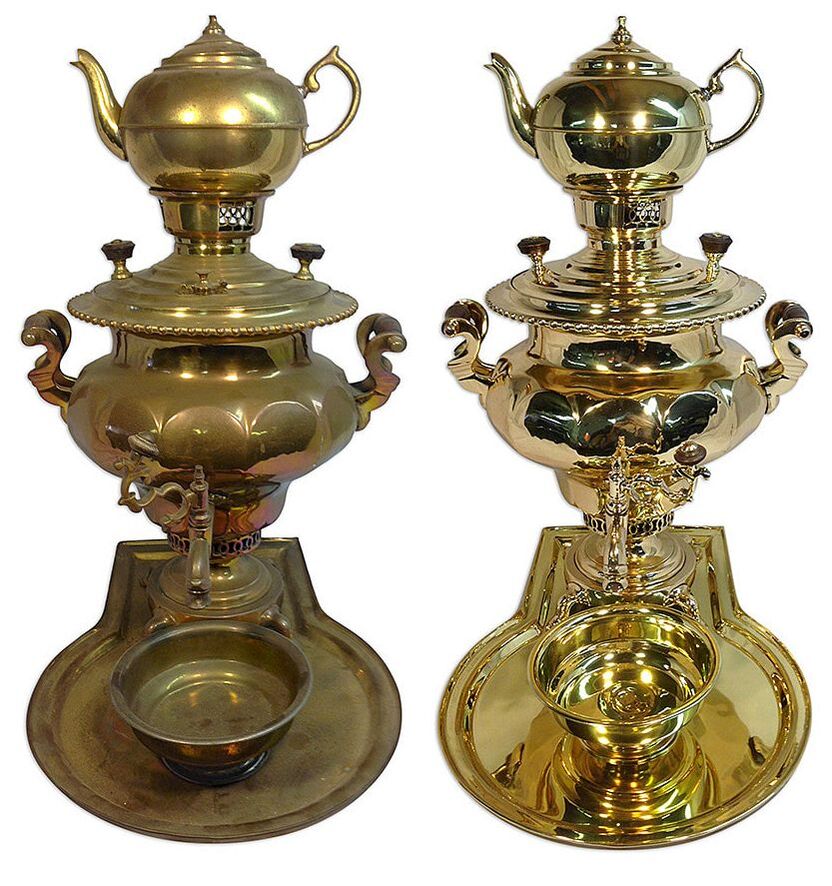
In restoration, each samovar is assessed as a whole—body, base, chimney, lid, spout, handles, and any matching tray or teapot. Old lacquer, soot, and surface contamination are removed to reveal sound metal. Brass samovars are then polished in stages so curves, molding lines, and embossed decoration are clarified without softening detail. Tone is adjusted to suit the age and character of the piece—some are brought to a bright, reflective finish; others retain a slightly warmer, older tone so engraving and modeling remain legible without looking newly manufactured. Selected European urns and hotel pieces are treated in the same way. Silver and silverplated examples receive appropriate silver cleaning and polishing, with tone adjusted so lids, taps, and bases read as a coherent set. |
SPOUTS, HANDLES, AND INTERIOR CONDITION
|
Many antique samovars arrive with taps that no longer line up cleanly, worn or darkened handle insulators, and loosened decorative elements. Within the limits of the original construction, fittings are cleaned, tightened, and brought back into sensible alignment. Tarnish and corrosion around joints and seams are reduced so transitions look intentional and long-standing water staining does not dominate the appearance.
Knobs, finials, and small ornaments are cleaned and, where possible, re-secured so they sit squarely. Dent reduction is approached cautiously, working from the interior when access allows. The aim is to soften obvious distortions that interrupt the line of the body while respecting the age and history of the piece. If a component is cracked, heavily distorted, or previously repaired in a way that cannot be reversed safely, this is discussed before any work proceeds. Interiors are lightly cleaned to remove loose corrosion, soot, and scale so they are visually tidy and stable. Re-tinning and full interior relining are not offered, and samovars are not modified for regular kitchen use. |
PROCESS, SHIPPING, AND DECORATIVE USE
|
After assessment and disassembly, samovars are cleaned, stripped of failing lacquer, and polished as agreed. Brass and copper pieces usually receive a clear lacquer to slow future tarnishing; some silver and silverplated examples may be left unlacquered, depending on how they will be displayed. In all cases, the goal is an even, appropriate finish that respects the age and origin of the object.
All work is carried out in the Philadelphia workshop. Before shipping, clients receive packing and shipping guidance for the body, lid, chimney, and any loose parts so handles and taps are supported rather than stressed. When restoration is complete, return shipping is arranged from the studio in line with that guidance. Restored samovars are best regarded as decorative pieces or used only for very occasional service at the owner’s discretion. The studio does not test water or certify food safety. Samovars should not be placed in dishwashers or left standing with water for extended periods. Exterior surfaces are easily maintained with light dusting and a soft cloth; abrasive powders and aggressive polishes are discouraged, as they can cut through lacquer or silver and undo the work of restoration. |
Send clear photos and dimensions to begin.
BEFORE AND AFTER GALLERY
The gallery below focuses on traditional Russian brass samovars restored in the Philadelphia workshop, along with a small number of related urns and trays. Many arrived with heavy tarnish, corrosion, soot, and failing lacquer, and left with clarified detail, adjusted tone, and stable finishes suited to long-term display.
|
|
|
FAQ
WHAT TYPES OF SAMOVARS DO YOU RESTORE?
Chelsea Plating Company primarily restores traditional Russian brass samovars with charcoal chimneys, taps, and side handles, along with selected European hot water urns and hotel pieces. Work commonly includes classic urn-shaped bodies, matching trays, and associated teapots or stands in brass, copper, nickel silver, silverplate, and sterling.
WHAT KINDS OF DAMAGE CAN YOU ADDRESS IN A SAMOVAR?
Tarnish, corrosion, soot, failing lacquer, and staining can often be reduced or removed. Light dents and distortions may be improved where the metal allows, and loose handles, taps, and decorative elements are tightened and aligned when possible. Deep structural damage or previous poor repairs are assessed case by case, and any limits are explained before work begins.
CAN A RESTORED SAMOVAR BE USED FOR HOT WATER OR TEA?
Restoration focuses on appearance and stability rather than preparing samovars for regular food service. Interiors are lightly cleaned but not retinned or relined, and the studio does not test water or certify food safety. Restored samovars are best regarded as decorative objects or used only for very occasional service at the owner’s discretion, with careful drying and storage after each use.
DO YOU OFFER RETINNING OR INTERIOR RELINING FOR SAMOVARS?
No. Interiors are cleaned to remove loose residues and improve appearance, but full retinning and interior relining are not offered. If a client’s primary goal is frequent food or beverage use, they are advised that the workshop cannot guarantee a food-safe result.
HOW DO I SHIP A SAMOVAR FOR RESTORATION AND REQUEST AN ESTIMATE?
All work takes place in the Philadelphia workshop. Before shipping, you receive packing and shipping guidance for the body, lid, chimney, and any loose parts so they are well supported and cushioned. When restoration is complete, return shipping is arranged from the studio. For an estimate, send clear photos of the full samovar and close-ups of the spout, handles, interior, and any notable damage, along with approximate dimensions and materials if known.
Chelsea Plating Company primarily restores traditional Russian brass samovars with charcoal chimneys, taps, and side handles, along with selected European hot water urns and hotel pieces. Work commonly includes classic urn-shaped bodies, matching trays, and associated teapots or stands in brass, copper, nickel silver, silverplate, and sterling.
WHAT KINDS OF DAMAGE CAN YOU ADDRESS IN A SAMOVAR?
Tarnish, corrosion, soot, failing lacquer, and staining can often be reduced or removed. Light dents and distortions may be improved where the metal allows, and loose handles, taps, and decorative elements are tightened and aligned when possible. Deep structural damage or previous poor repairs are assessed case by case, and any limits are explained before work begins.
CAN A RESTORED SAMOVAR BE USED FOR HOT WATER OR TEA?
Restoration focuses on appearance and stability rather than preparing samovars for regular food service. Interiors are lightly cleaned but not retinned or relined, and the studio does not test water or certify food safety. Restored samovars are best regarded as decorative objects or used only for very occasional service at the owner’s discretion, with careful drying and storage after each use.
DO YOU OFFER RETINNING OR INTERIOR RELINING FOR SAMOVARS?
No. Interiors are cleaned to remove loose residues and improve appearance, but full retinning and interior relining are not offered. If a client’s primary goal is frequent food or beverage use, they are advised that the workshop cannot guarantee a food-safe result.
HOW DO I SHIP A SAMOVAR FOR RESTORATION AND REQUEST AN ESTIMATE?
All work takes place in the Philadelphia workshop. Before shipping, you receive packing and shipping guidance for the body, lid, chimney, and any loose parts so they are well supported and cushioned. When restoration is complete, return shipping is arranged from the studio. For an estimate, send clear photos of the full samovar and close-ups of the spout, handles, interior, and any notable damage, along with approximate dimensions and materials if known.
Send clear photos and dimensions to begin.
RELATED PAGES
- Brass, Copper and Bronze Restoration and Repair — Broad restoration and refinishing of brass, copper, and bronze objects.
- Brass Restoration and Repair — Fireplace pieces, samovars, candlesticks, and decorative brass objects.
- Brass Polishing and Cleaning — Surface cleaning, polishing, and tone adjustment for brass.
- Silver Restoration and Repair — Polishing and repair for silver and silverplated wares.
- Request an Estimate — Send photos and dimensions to discuss a restoration project.