SILVER PLATING AND REPLATINGReplating worn silverplate tableware, hollowware, candlesticks, trophies, and decorative objects.
Chelsea Plating Company in Philadelphia restores worn and uneven silverplate for clients in the city and throughout the United States. Silver plating and replating are used when underlying base metal shows through or when original silver surfaces have thinned beyond what careful polishing alone can correct. Typical projects include serving bowls and covered dishes, candlesticks and candelabra, tea and coffee services, trays, toast racks, and selected trophies and presentation pieces. Each piece is evaluated for structure, remaining original plate, and intended use before any new silver is applied. Many clients first find the workshop while searching for silver plating or silverplate restoration near them and then choose to ship their pieces to Philadelphia once they see how much can be clarified and stabilized.
Send clear photos and dimensions to begin.
|
AT A GLANCE — SILVER PLATING AND REPLATING
|
SILVERPLATE HOLLOWWARE AND TABLEWARE REPLATING
|
Many silver plating projects at Chelsea Plating Company begin with hollowware: serving bowls, covered dishes, butter dishes, toast racks, and hot water or coffee urns. Over years of use and polishing, the original silver layer on these pieces can thin, exposing a warm copper or yellow base metal and leaving an uneven, patchy appearance. Before any new plating is considered, each piece is examined for structural soundness, including soldered joints, handles, feet, and any mechanical elements such as hinges or rotating covers.
Where the underlying structure is stable and the original form is worth preserving, worn areas are prepared with careful cleaning and local refinement rather than broad, aggressive abrasion. New silver plate is then applied to bring exposed base metal back to a silver tone and to even out highly mottled fields. Interior surfaces that come into contact with food are treated with particular care. The goal is a calm, coherent read that respects original contours and wear patterns while resolving distracting contrast between base metal and remaining silver. |
TEA AND COFFEE SERVICES, TRAYS, AND CANDLESTICKS
|
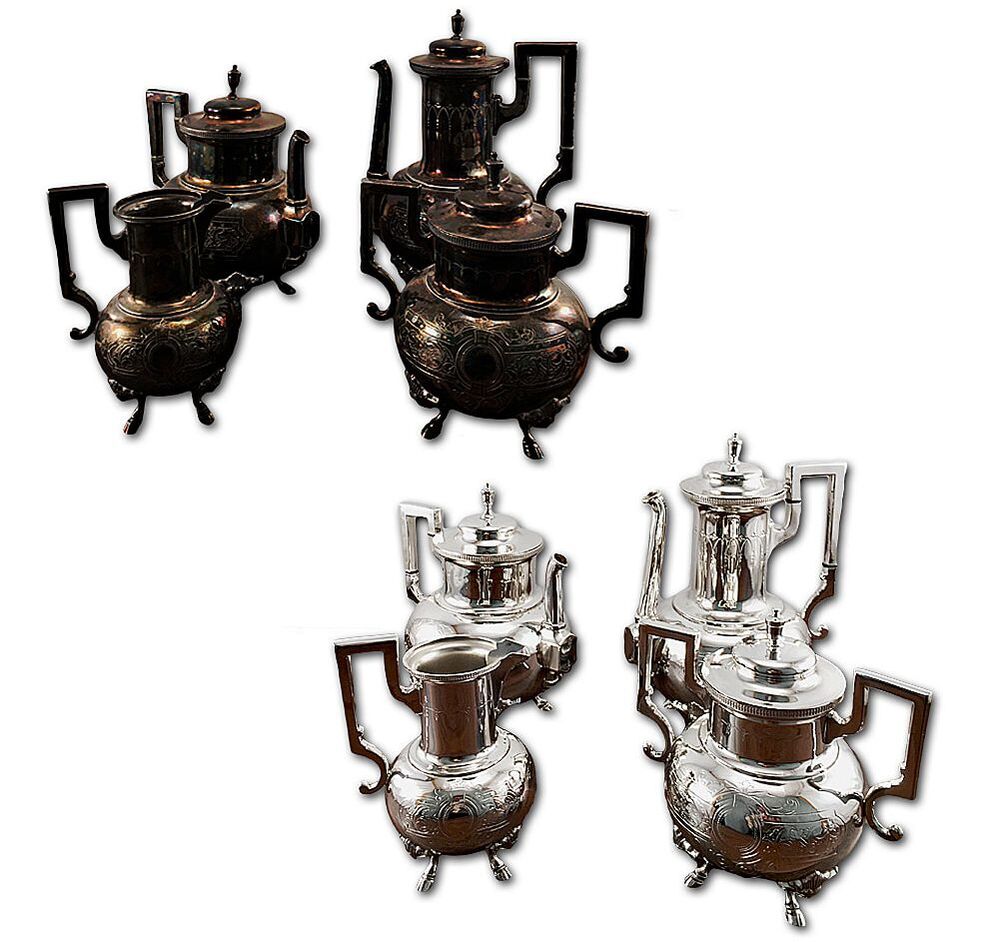
Tea and coffee services and their trays often show a mix of issues: local base-metal exposure on handles and rims, thin plating on broad flat areas, and a general lack of uniformity across pieces that were originally part of a matched set. Services are treated as groups so that structural corrections, surface preparation, and replating are coordinated across pots, sugar bowls, creamers, waste bowls, and associated trays. Where new silver is applied, thickness and sheen are tuned so the set reads as a unified service rather than a collection of mismatched replacements.
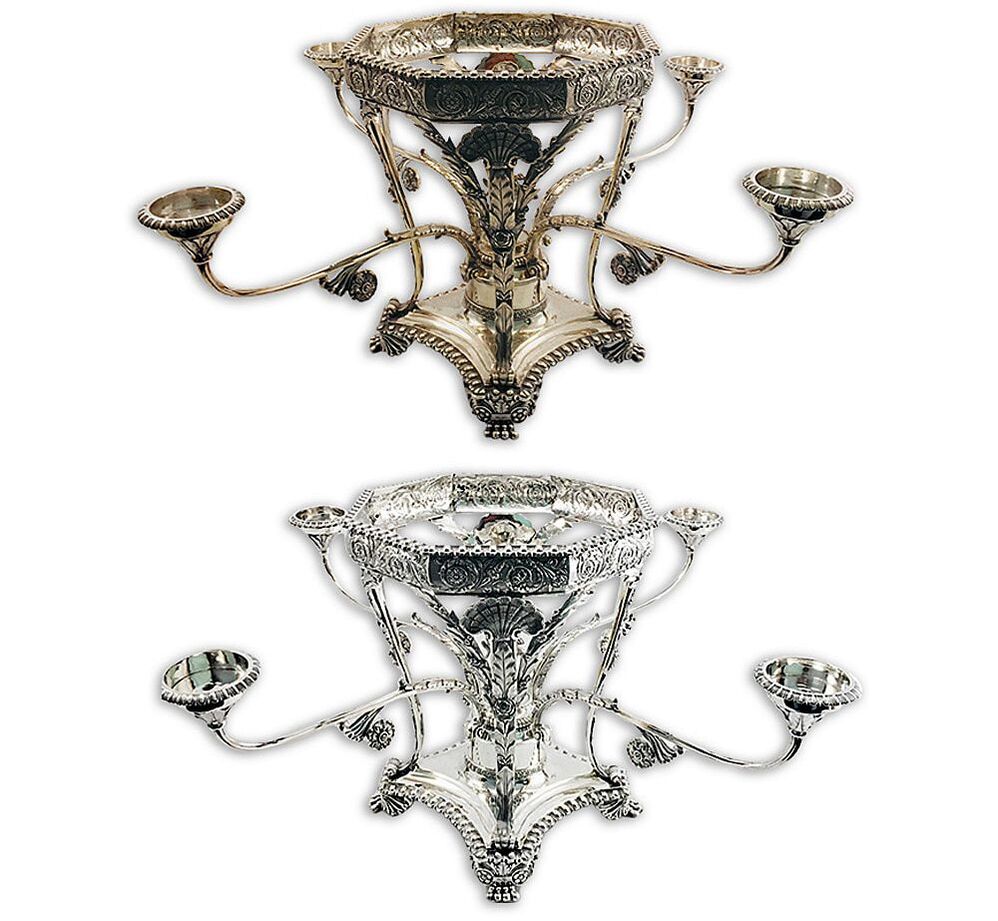
Candlesticks and candelabra in silverplate may present as dull and coppery where plate has worn through on edges and high points. After checking joints and stabilizing bases and arms as needed, worn areas are prepared so that new plate can be deposited without softening crisp moldings and ornament. In many cases, replating allows a strongly designed but visually tired candlestick or centerpiece to sit comfortably again among sterling and other silver on a table or sideboard. Honest signs of age can remain in recesses and sheltered areas, keeping the piece appropriate to its period rather than making it look newly manufactured. |
WHEN PLATING IS AND IS NOT APPROPRIATE
|
Not all worn silverplate needs or benefits from replating. Some pieces respond well to careful cleaning and polishing alone, particularly where the original silver layer is still substantial and base metal is not widely exposed. In these cases, the aim is to clarify the existing finish and preserve remaining plate rather than thinning it further. The workshop can often advise from photos whether a piece is a good candidate for cleaning only or whether replating is likely to be necessary.
Other pieces—especially those with extensive base-metal exposure, deeply thinned plate, or earlier harsh polishing—may be better served by new silver plating if their structure is sound and their use justifies the work. There are also clear limits. Extremely thin or fatigued shells, pieces with heavy pitting and corrosion, or objects where underlying construction has failed may not be good candidates for replating. In those cases, alternative treatments or more conservative stabilization can be proposed so the object can still be handled and displayed without promising results that the material cannot support. |
PROCESS, SHIPPING, AND PROJECT SCOPE
|
Most silver plating projects begin with clear photos and basic dimensions of the piece or set. From these, the workshop can usually provide an initial treatment range and note any visible concerns, such as prior repairs, bent components, or areas where the base metal already shows strongly. Once the piece arrives at the Philadelphia workshop, it is examined at the bench. Structural issues and soldered joins are tested and corrected as needed before any surface preparation or plating proceeds, and a written estimate is confirmed with the client.
Preparation for plating focuses on cleaning, reducing tarnish and residues, and locally refining surfaces that must receive new silver, without erasing evidence of handwork or over-thinning edges and relief. New silver plate is applied to bring worn areas back into line with the surrounding surfaces. After plating, pieces are carefully rinsed, dried, and given a controlled finish, from soft to bright, appropriate to their form and intended use. Clients ship pieces to the Philadelphia workshop after receiving packing guidance, and return shipping is arranged from the studio when work is complete. Only objects that can be safely packed, shipped, or hand-delivered are accepted; no on-site work is offered. |
Send clear photos and dimensions to begin.
BEFORE AND AFTER GALLERY
The silver plating gallery shows typical outcomes for worn silverplate that has been evaluated, stabilized, and replated where appropriate. Some pieces required extensive replating to address widespread base-metal exposure, while others primarily needed careful cleaning, repair, and limited new silver to unify local losses. In all cases, the focus is on restoring a coherent silver appearance and stable structure while preserving as much original material and character as the piece allows.
|
|
|
FAQ — SILVER PLATING AND REPLATING
WHAT TYPES OF OBJECTS ARE SUITABLE FOR SILVER PLATING AND REPLATING?
Chelsea Plating Company replats silverplate tableware and hollowware such as serving bowls, covered dishes, toast racks, butter dishes, and hot water or coffee urns, as well as candlesticks, candelabra, trophies, and selected religious and decorative objects. In general, the work focuses on pieces originally made with electroplated silver over a sound base metal and whose form and use justify the intervention.
HOW DO I KNOW IF MY SILVERPLATE NEEDS REPLATING OR JUST POLISHING?
If gentle polishing still leaves broad, patchy areas where warm base metal shows through, or if a piece no longer reads as silver when set beside other silver on the table, it may be a candidate for replating. In other cases, where original plate is still substantial and base metal is not exposed, careful cleaning and polishing may be sufficient. Clear photos of the whole piece and close-ups of the most worn areas usually allow the workshop to advise whether cleaning, replating, or a combination is appropriate.
WILL REPLATING CHANGE ENGRAVING, MONOGRAMS, OR PATINA?
Preparation for plating is conservative and focuses on preserving engraved decoration, monograms, and maker’s marks. Abrasion is kept to the minimum needed for new silver to adhere. New plate will brighten the overall appearance and reduce contrast between worn and unworn areas, but age, fine scratches, and gentle softening of high points are often left so the piece still feels appropriate to its history. Any concerns about inscriptions or patina can be discussed as part of the estimate.
ARE ALL SILVERPLATE OBJECTS GOOD CANDIDATES FOR REPLATING?
No. Very thin or structurally fatigued silverplate, pieces with extensive deep pitting, and objects whose underlying construction has failed may not be suitable for replating. Elements such as wooden handles, fragile inserts, or non-metallic components can also limit what can safely be done. In these cases, treatment may focus on stabilization and cleaning rather than new silver, and the workshop will explain any limits before work begins.
HOW DOES SHIPPING WORK FOR SILVER PLATING PROJECTS?
All silver plating work is completed in the Philadelphia workshop. Before you ship, you receive packing guidance so pieces are supported and protected in transit. Clients ship pieces to the workshop, and when the project is finished, return shipping is arranged from the studio. No on-site plating or repair is offered.
Chelsea Plating Company replats silverplate tableware and hollowware such as serving bowls, covered dishes, toast racks, butter dishes, and hot water or coffee urns, as well as candlesticks, candelabra, trophies, and selected religious and decorative objects. In general, the work focuses on pieces originally made with electroplated silver over a sound base metal and whose form and use justify the intervention.
HOW DO I KNOW IF MY SILVERPLATE NEEDS REPLATING OR JUST POLISHING?
If gentle polishing still leaves broad, patchy areas where warm base metal shows through, or if a piece no longer reads as silver when set beside other silver on the table, it may be a candidate for replating. In other cases, where original plate is still substantial and base metal is not exposed, careful cleaning and polishing may be sufficient. Clear photos of the whole piece and close-ups of the most worn areas usually allow the workshop to advise whether cleaning, replating, or a combination is appropriate.
WILL REPLATING CHANGE ENGRAVING, MONOGRAMS, OR PATINA?
Preparation for plating is conservative and focuses on preserving engraved decoration, monograms, and maker’s marks. Abrasion is kept to the minimum needed for new silver to adhere. New plate will brighten the overall appearance and reduce contrast between worn and unworn areas, but age, fine scratches, and gentle softening of high points are often left so the piece still feels appropriate to its history. Any concerns about inscriptions or patina can be discussed as part of the estimate.
ARE ALL SILVERPLATE OBJECTS GOOD CANDIDATES FOR REPLATING?
No. Very thin or structurally fatigued silverplate, pieces with extensive deep pitting, and objects whose underlying construction has failed may not be suitable for replating. Elements such as wooden handles, fragile inserts, or non-metallic components can also limit what can safely be done. In these cases, treatment may focus on stabilization and cleaning rather than new silver, and the workshop will explain any limits before work begins.
HOW DOES SHIPPING WORK FOR SILVER PLATING PROJECTS?
All silver plating work is completed in the Philadelphia workshop. Before you ship, you receive packing guidance so pieces are supported and protected in transit. Clients ship pieces to the workshop, and when the project is finished, return shipping is arranged from the studio. No on-site plating or repair is offered.
Send clear photos and dimensions to begin.
RELATED SILVER PAGES
- Silver Restoration and Repair — Overview of silver restoration and repair services.
- Silver Repair — Structural repair of sterling and silverplate before finishing.
- Sterling Silver Polishing and Cleaning — Controlled polishing for sterling silver tableware and decorative pieces.
- Request an Estimate — Send photos and dimensions to begin your project.